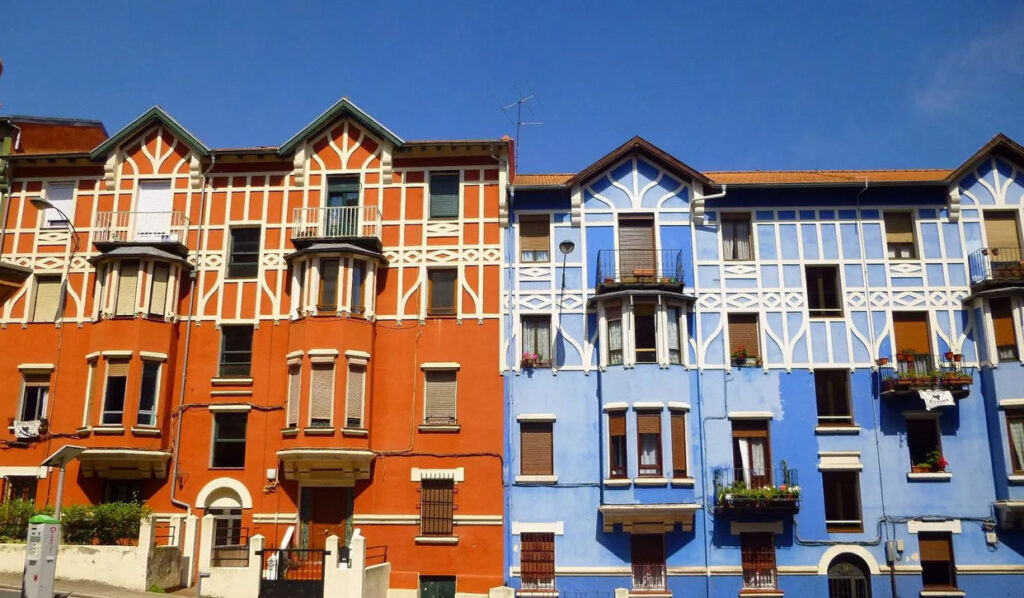
Bilbao also has surprising spots when you get a little bit off the beaten track. One of them is in Irala, a neighbourhood with a lot of personality where the colourful facades turn some of its streets into some of the most unusual and recognisable images of the city.
It’s no accident that a lot of people compare it with Notting Hill, there are also rows of houses with a British feel and in striking colours with an urban image that completely breaks from the more traditional idea of Bilbao.
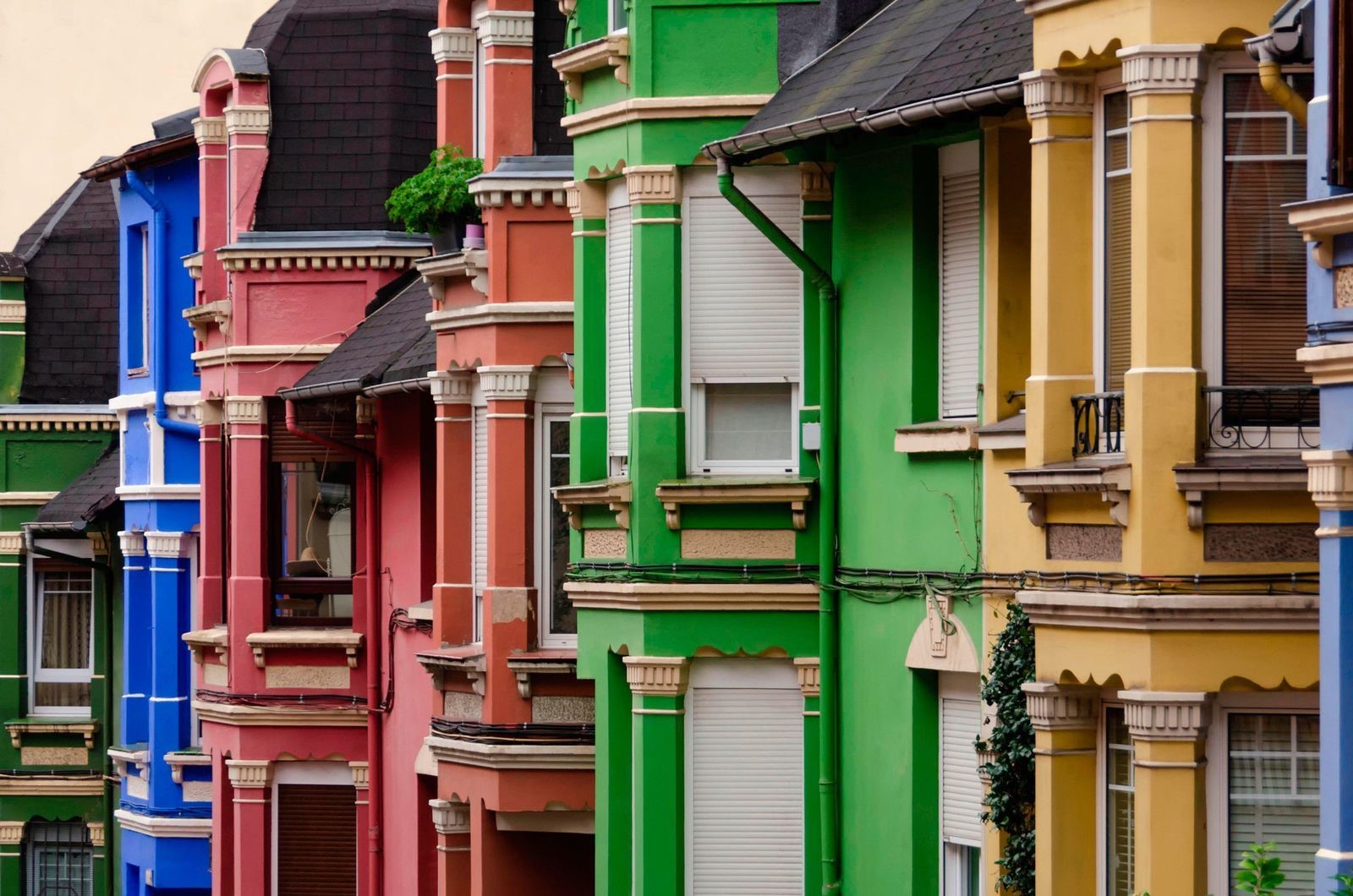
Part of the charm of this spot lies in its history. Irala was born at the start of the 20th century in the context of Bilbao’s industrial expansion, and the neighbourhood was driven by Juan José Irala with the idea of creating housing for workers near the factory.
The project was not limited to building houses. It also included facilities and a neighbourhood concept very much tied to the garden city model, which was an approach to urban planning inspired by ideas born in England as an alternative to the harsh industrial cities.
That explains precisely why these houses are so different. A lot of them are semi-detached, brightly painted, English inspired and they have small courtyards or gardens, something quite uncommon in the most-recognisable image of Bilbao. Its most emblematic streets are around Kirikiño, Baiona and Zuberoa where the image that has turned the neighbourhood into one of the most photographed spots in the city is concentrated.
The nice thing about visiting Irala is that it doesn’t feel like an isolated stage-set, but like a neighbourhood with a life of its own. Walking around the area lets you discover a side of Bilbao that is less monumental and more day-to-day, but also very special from a visual point of view. The draw here is not a large museum or an internationally famous architectural icon, rather it’s the place as a whole, its steep streets, the repetition of coloured facades and the mixture of working-class history and an almost cinematic aesthetic.
Furthermore, the neighbourhood is more interesting than it seems at first sight. The Harino Panadera building is located very close to the houses. The factory is tied to the origins of the neighbourhood and it’s one of the most important heritage sites in the area. There are also other points of interest, like the church of San Luis Beltrán or the nearby Vista Alegre, which let you complete the walk with a broader reading of the urban evolution of this side of Bilbao.
The coloured houses of Irala are, in short, one of those places that show that Bilbao still has spots that can be surprising, even for people who think they know the city very well. A short, different and very pleasant walk for discovering a less-obvious side of Bilbao that is more local and extremely charming.
What makes the coloured houses of Irala special
- They have an appearance that is very uncommon in Bilbao and that has clear English inspiration.
- They’re part of a neighbourhood created in the early 20th century with ties to the industrial development of the city.
- They are concentrated mostly on Kirikiño, Baiona and Zuberoa streets.
- They’re one of the most visual and photogenic spots in Bilbao.
Practical Information
Location: neighbourhood of Irala / Iralabarri south of the centre of Bilbao.
Recommended streets for walking: Kirikiño, Baiona and Zuberoa
Perfect For: A different urban walk, taking pictures and discovering a less-common spot in Bilbao
Establishments nearby





Accommodation nearby